Celtic Festival in Warwick
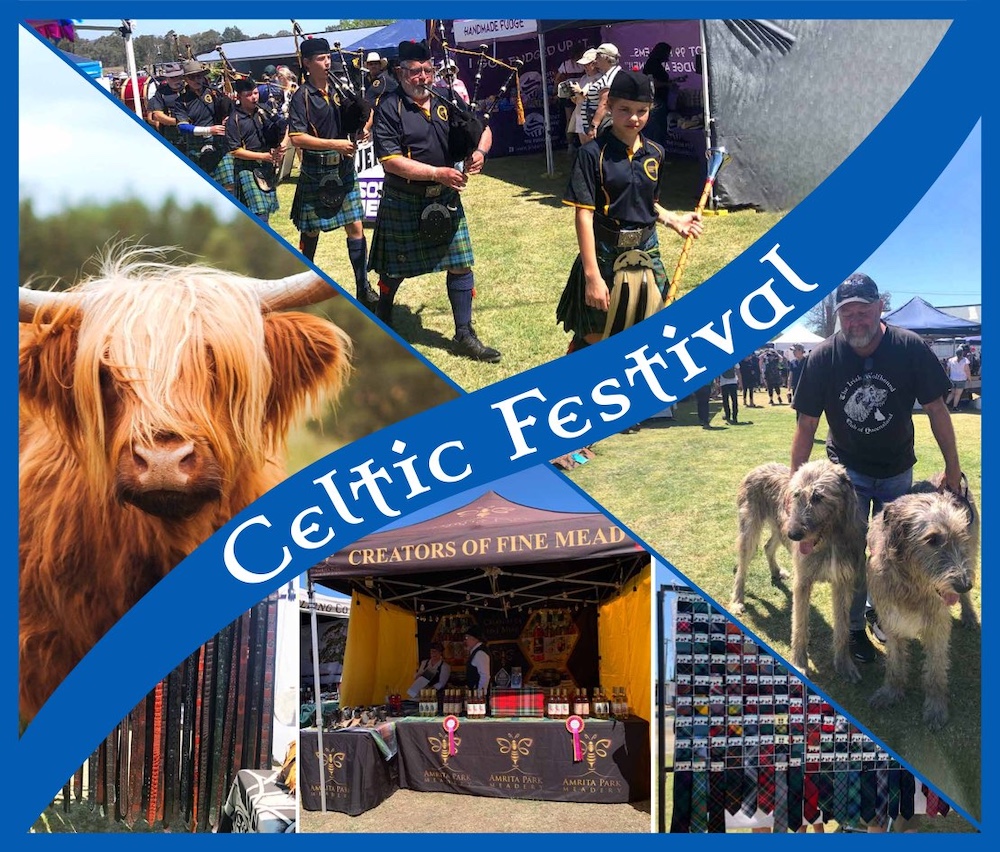
This edition our front cover depicts a Celtic Festival held in Warwick, a biannual event with the next one planned for 2027. The Festival has been moved to be held on the "King’s Weekend" on the first weekend of October.
When we visited the Festival on Saturday 4th October 2025, we could see the work with which the store holders had created origin trinkets and stories to celebrate history. Many visitors had come to celebrate the music, being played by local Warwick bands, and bands from Brisbane, Toowoomba, Moreton Bay, and Redcliffe.
It was hard to decide which image to put on the cover. There were so many wonderful choices. We thought that a pipe band is a signature of the modern 'Celts' and must therefore be included. You can see the Toowoomba Caledonian Society Pipe Band on the cover with young Emily as the drum major.
We also included the Highland cow picture, another signature of the Celtic Scottish tradition. Moreover, these cows are also bred by a local producer Keans Agri Leyburn Highland Stud.
Celts produced many fine drinks, with mead being another well known traditional Celtic drink. This fermented honey drink was considered a drink of wisdom and was important part of rituals and celebrations. We have put on the cover a stall of Amrita Meadery from the Sunshine Coast near Noosa region.
To the right of the Mead stall there is a display of ties with traditional Scottish designs. On the left of the Mead stall there is a display of belts, each with some Celtic-like symbols carving.
Near the entrance we 'stumbled' upon a man with two Irish Wolfhounds. They were magnificent. So they share the front cover image as well.
There was a great feel of pride in the exhibitors and many visitors alike of the ancestry, the heritage and the culture still kept deep in their veins.
Some proud family clans exhibited their ancestral ties. We could learn about Forby Sutherland who was the first British (Scottish really) man to die and be buried in Australia. He died of consumption on the 1st May 1770 in Sydney. Captain Cook named the point with his grave in the bay the Sutherland Point.
Do you know why thistle is the emblem of Scotland? The legend tells that the Danes tried to attack Scotland during one dark night and fell into a field of thistles. They started screaming and thus alerted Scots who subsequently defeated the attackers. The emblem includes the words 'nemo me impune lacessit', meaning 'no one attacks me with impunity'.
There were numerous food and drink stalls at the Festival. Something for young and old, lollies, teddy bears, walking sticks.
You could even learn to dance Irish dances in the great hall - or you could have your fortune telling or conversations with a shamanic-style mystic healer Raven Sage.
An now just a bit of history.
While Celts seem to have started in about 1200 BC, the earliest evidence of evolving Celtic culture comes from Hallstatt, Austria (c. 700 BC), linked to powerful chieftains who controlled trade routes. They developed with a Hallstatt culture. In German 'stadt' is town or city.
The much later La Tene Culture evolved from the Hallstatt culture around 450 BC, characterised by more advanced and decorative artifacts.
From about 800 BC or 700 BC, the Celtic tribes spread from central Europe into areas such as France, the Iberian Peninsula or Spain and Portugal as Celtiberians, Britain as Britons and Gaels, and even into Asia Minor as Galatians; bible readers know of Saint Paul's letter to the Galatians in about 60 AD.
The Celtic social structure developed as a society which was hierarchical, with chiefs, warriors, and religious leaders (Druids) at the top, followed by farmers and traders.
They practiced a polytheistic religion with a father god and a mother goddess, often associated with fertility or the land. The Druids were academic and priestly figures who held significant power and were exempt from military service. Some historians believe that Jesus, as a boy carpenter travelling with his great uncle Joseph of Arimathea, a wealthy tin trader, had visited Cornwall, and had conversed with some Druids, and many others, at St Just-in-Roseland where a church is built 'on his footsteps'. And walked on Looe Island (also known as, or next to, St George's Island, with St Michael's Mount now a cafe), and legend says Jesus had built a hut in Cornwall; a prime Celtic area. He might also have gone to India and Nepal. Technically, Cornwall, like Scotland and Wales, is not part of England. It is a separate Duchy, but, of course, part of Great Britain.
Many Celtic villages had hill forts for protection, a prominent feature of their settlements. Celtic art was known for its intricate craftsmanship, visible in items like combs and rich jewellery. Celtic peoples were united by their use of Celtic languages, which still survive today in the Celtic nations.
They were a collection of loosely affiliated tribes, not a single, unified state. Celts shared distinctive art styles, religious beliefs, burial practices, and a love for intricate, decorated objects.
Most European Celtic groups were absorbed into the Roman Empire, but their culture and language continued to thrive in more remote areas. Scotland, Ireland and Wales despite many attempts were not conquered by the Romans. Eventually, The Romans had to build Hadrian's wall to stop the marauding Scots from attacking the northern Roman outposts in Britain. The Welsh mountains prevented most of Roman attacks. And the Irish sea probably was just too much to bother crossing at the edge of the Roman Empire, with probably proud Celts defending the island of Ireland.
The linguistic and cultural descendants of the Celts can be found today in Ireland, Scotland, Wales, Brittany, Cornwall, and the Isle of Man, mainly because most of these areas were just outside the Roman Empire.
Since 1788, many of the settlers in Australia have come from these Celtic districts of Britain and Ireland. So, there is a true celebration of Celtic heritage here in Warwick, where many families from Ireland, Wales, Cornwall, Brittany and Scotland have settled.
Written by
Gerry & Nevenka Clarke, Pocket Books
P.S. On Gerry's mother's side, Nancy Catherine Clarke, nee Hardy, he also has Scottish heritage through the MacDonald and the MacKillop clans and Hardy family, and he is a direct descendant with 1788 First Fleet heritage from Esther Eccles, also known as Eleanor Wainright, from the town of Rishton in Northern England. Gerry's father, Calvert Croxson Clarke, with Irish and English heritage, was based for a short time, at Warwick, in 1943, after returning from Cairo Egypt where he had been the Supply Staff Sergeant for General Blamey's office.
Nevenka is originally from Slovenia (next to Austria) where many Celtic remnants still exist to-date.
Photos: Pocket Books
Highland Cow photo: Courtesy of Valdemaras D.
Pocket Books 5438 1881
sd@pocketbooks.com.au