This time we feature a unique park in Inglewood, which others would wish to emulate - but first a bit of history of the town.
MacIntyre Brook
On 28th May 1827, explorer Allan Cunningham came into what was then colonial undiscovered territory south of Inglewood. See Map B B4 and Map 7 C2 in this book.
Mr Allan Cunningham crossed and named the MacIntyre Brook on Wednesday 30th May 1827. This led to his discovery and naming of the Darling Downs. The area was named after Governor Ralph Darling of Sydney as all of the Eastern Part of Australia was then generally named by Captain Cook in 1770 as looking like the south of Wales. Ralph ruled NSW harshly from 19th December 1825 till 22nd October 1831.
In 1840 the first white settlers followed in Allan's footsteps, to settle the area. This settlement was known as Brown's Inn and was on the other side of the Brook, about 600m to the north-east of the present town. On the north-west part, Rabbits Hill, map 7 A1, is 355 m above sea level, with a tank; while much of the sounding slopes area is more than 300m.
Surveyed town in 1862.
Maybe in 1862 the surveyor LF Landsberg could have considered the gentle slopes of Rabbits Hill which would have made the town safer from floods. The current town is 287m above sea level at the rest area next to MacIntyre Brook. That is an extra 13m. The town surveyor over at Texas knew that a few metres make a difference when, in about 1920, he moved most of the town up the hill.
Major Highway
Inglewood has the major Cunningham Highway going through the town as Albert St. This is one of the few towns in South-East Queensland which has businesses on a highway.
Lake Coolmunda
Lake Coolmunda is about 10 km west of Inglewood where Michele at MihardWork designs and makes lead-lighting and mosaics. See Map B C5, and see 'Glass' in this book.
Apex - Lions Park
Back to the park. This rest area has interesting information titbits about characters who made the town.
Read about the 1890's Roderick McLeod: his fall from a horse, and, his head stitches! Mr McLeod tenacity was incredible. During the mustering he fell off the horse and lost most of his scalp. He put his hat on the head to keep the scalp on and continued working while his son rushed to 60km-away town of Stanthorpe to get the doctor. The doctor was stitching his scalp back onto the head at the light of a lantern held by Mr McLeod's wife. She was so shattered that her hands, and the lantern, were visibly shaking. Mr McLeod took the lantern out of his wife's hands and held it calmly by himself. All this work was done without anaesthetic.
On another plaque there is a story about the Inglewood Royal Hotel. In 1840s Mr and Mrs Brown built the Brown's Inn on the north east side of the MacIntyre brook (as mentioned above). The story goes that Mr Brown was murdered by his cook. Mrs Brown shifted her inn to the south side of the brook to the corner of Victoria and Callandoon Streets. The hotel was later moved to its current location on the corner of Elizabeth and Albert Streets. It was renamed to the Royal Hotel.
A more recent plaque commemorates another beloved Inglewood man, Thomas Campbell. Mr Campbell was a scout master for many years and his tragic death in 1987 echoed in the community.
The Sundial
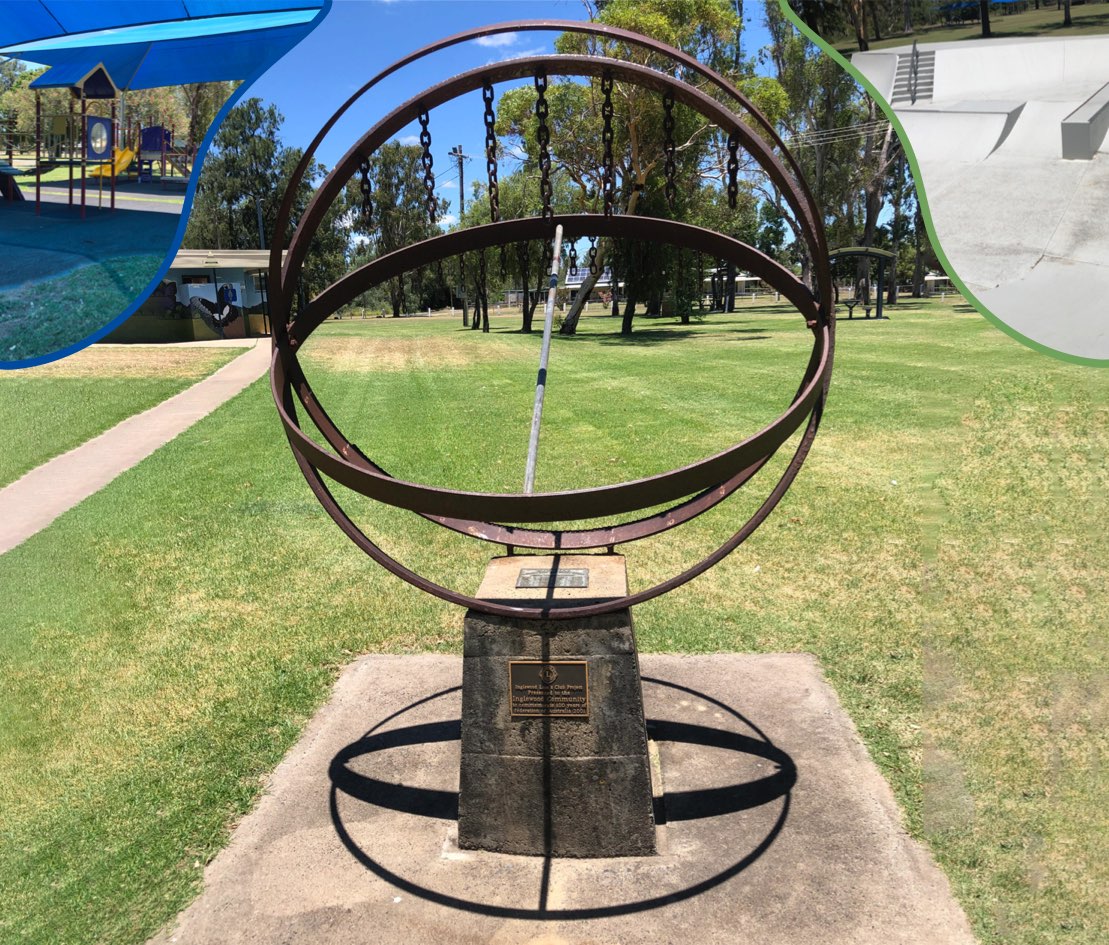
The Sundial (featured on the cover) is positioned at 28.413447° S and 151.084390° E. The ten-hour timeline away from 0° Greenwich England is the 150° line at a creek on the Barwon Hwy just south of Mobandilla, some 12km east of Toobeah. This is the base for our Queensland time. Perhaps it could be named Ten-Hour Creek.
The sign on the Sundial structure says "Inglewood Lions Club project. Presented to the Inglewood Community to commemorate 100 years of federation of Australia 2001."
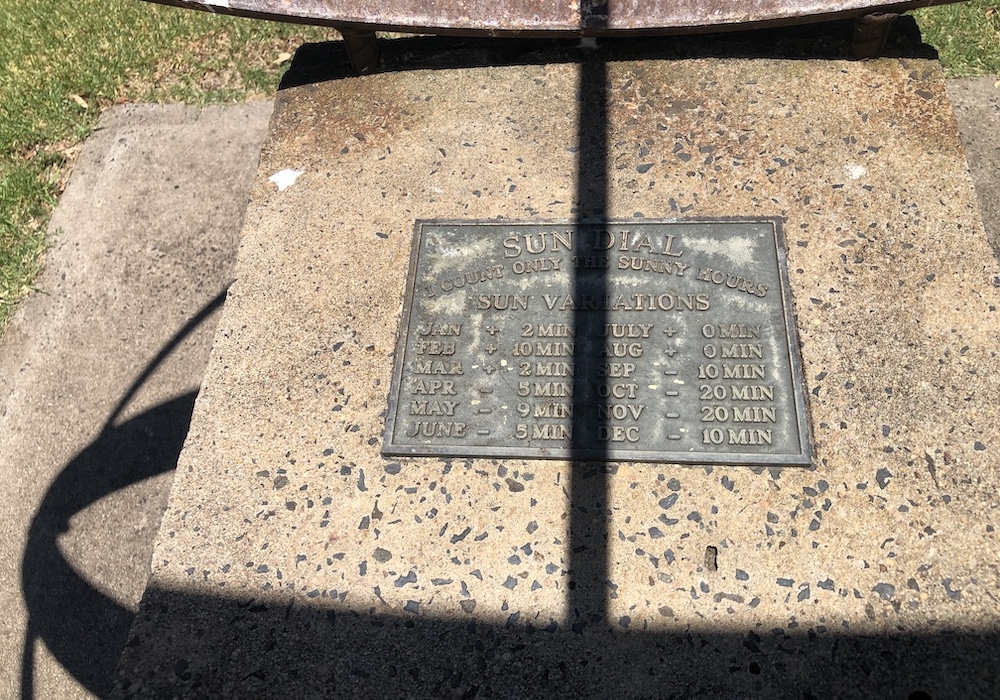
The monthly sun variations from the Inglewood times we use can be read at the base of this Inglewood sundial.
January + 2min
February + 10min
March +2min
Apr - 5min
May - 9min
June - 5min
July + 0min
August + 0min
September - 10min
October - 20min
November - 20min
December - 10min
You can see from the pic below that it was taken at about 12 noon or midday, 12:05 to be precise (the shadow of the rod goes approximately through the middle).
Today's Park features
More for modern today are the elements of the Apex-Lions Park providing service to the inter-generational community and visitors.
Playground
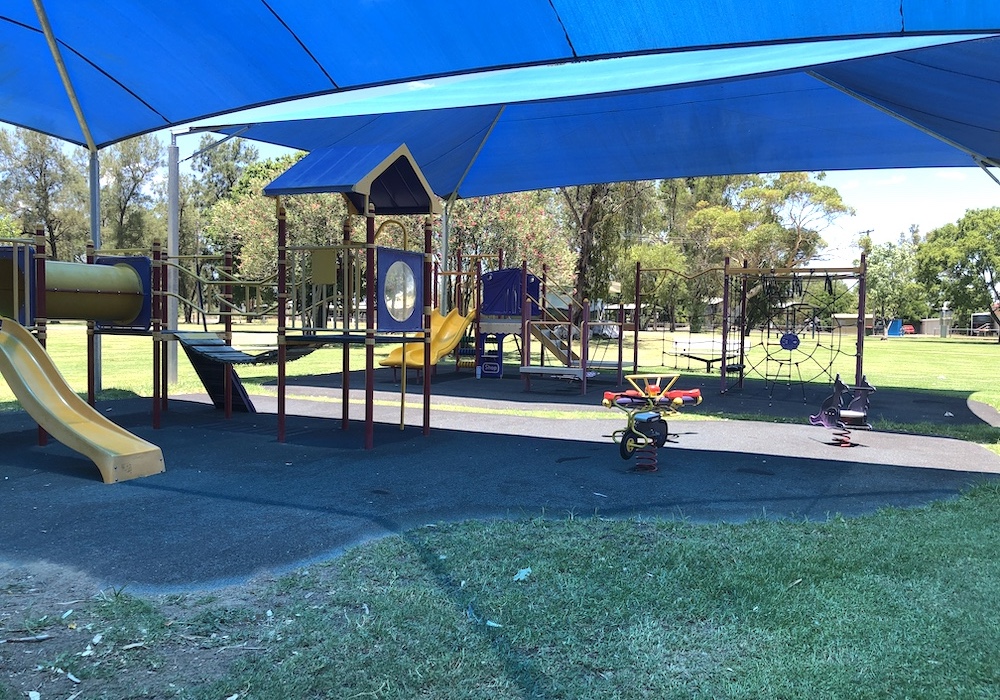
Playground includes traditional swings, but with multi-colours and a soft-landing foam. A covered area provides well appreciated shade for a slide for juniors, the metre high walk and the rope-web climb.
Skate Bowl.
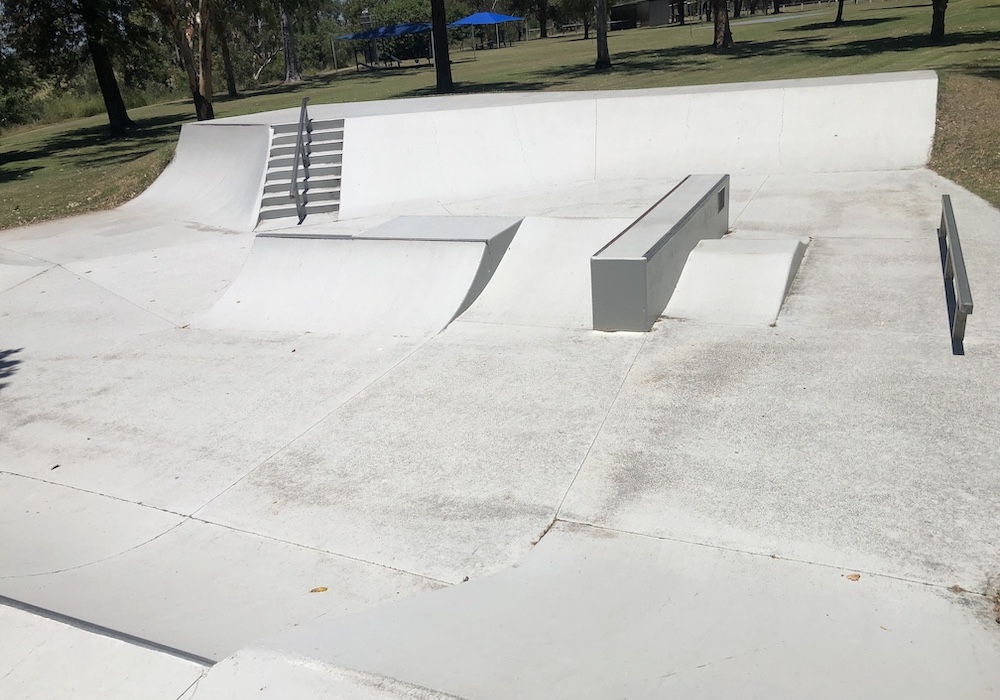
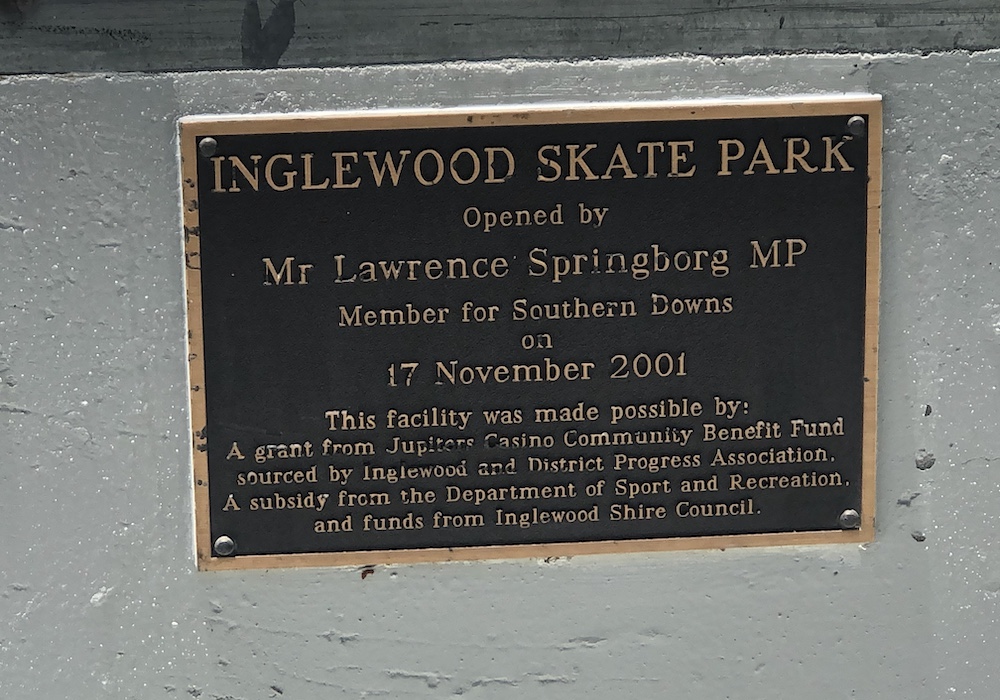
The skate bowl was opened on Saturday 17th November 2001 by Mr Lawrence Springborg, then Member of Qld Parliament for Southern Downs. It includes a variety of ramps for various skill levels.
Picnic Tables
Several roofed picnic tables, and an electric bar-be-que, make life nice for residents and visitors.
Toilet Block
Well, this 'convenience' is really special, with the 'butterfly' artwork painted around the building. Its fragments can be seen on the front cover.
1 km or 2 km walk
At the east of this rest area is a 'walk and cycle track' which goes under the bridge and into the town. There is a one km version, or two kilometres.
Trees
Behold, sometimes in awe, the large trees, and idyllic rows of trees at the rest stop and in main street of Inglewood.
Unique exercise facility
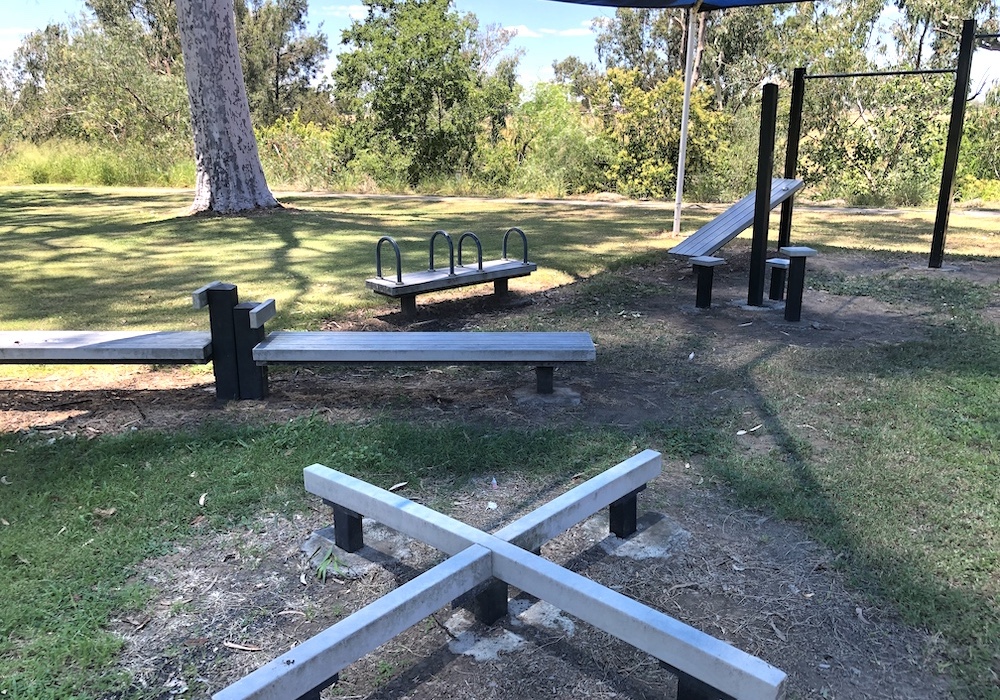
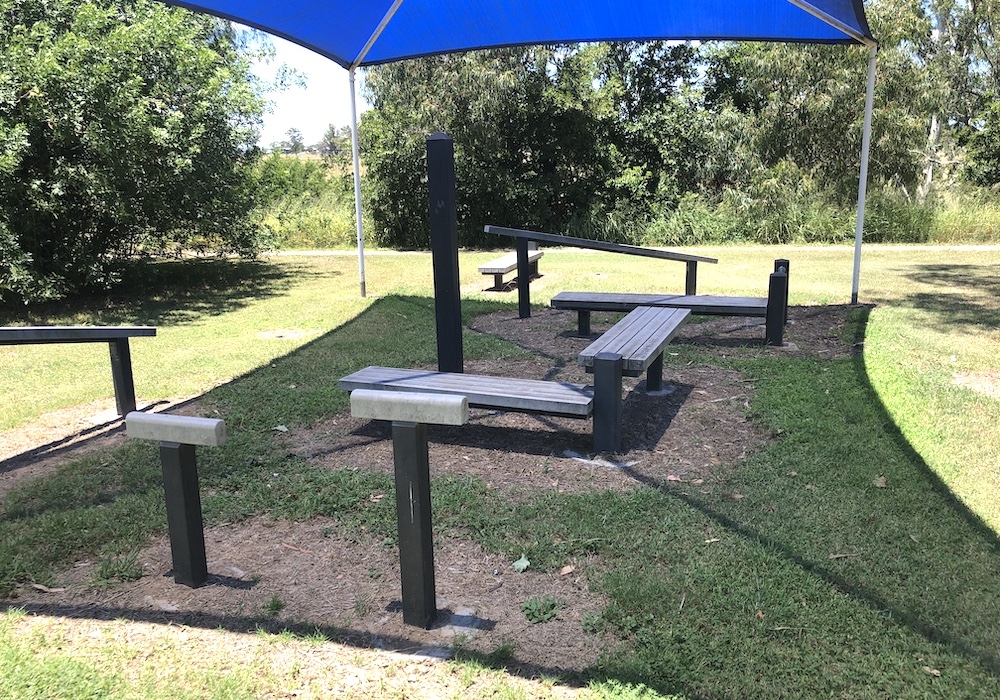
In the southern section of the Apex-Lions Park are the unique exercise information on three charts, along with exercise chairs, tables and step-ups.
Welcome Board - 'Fitness Can Be Fun' explains the workings of the information on the boards.
This special set of fitness program and the exercise equipment was designed by Fitnesstrails in Woden, ACT - see fitnesstrails.com. They called their program EXERSITE.
They state on the board:
'We invite you to enjoy the EXERSITE where you can turn fitness into invigorating fun! This unique outdoor recreational activity is scientifically designed to condition your entire body. Whether you wish to tone up, trim down, improve your fitness for your sport or just get fit, the EXERSITE will help you achieve your aim.'
Exercises in this program are combined into a few series of essential type of activities.
Stretching - Series 1 consists of stretching exercises to warm up or cool down at the end of the program.
Strengthening - Series 2, 3 & 4 consist of exercises for legs, body and upper part of the body. Each part has three exercises.
Cardiovascular Conditioning - At the end of each series of exercise, they recommend to do a few minutes of cardiovascular exercise - walking, swimming, cycling.
On the 'Heart Check' board there is a slogan 'To be FIT, think F.I.T.', explained as:
F - Frequency (recommended at least three times per week)
I - Intensity (recommended to exercise enough to elevate the pulse rate)
T - Time (recommended to 'maintain the heart rate within your training zone for at least 20 consecutive minutes'.)
Program like this could perhaps present an interesting diversification to your usual paid gymnasium.
Needless to mention, one should exercise to one's ability and build up strength and intensity of exercises progressively.
On your trip to the outback this park in Inglewood is not to be missed.
Written by Pocket Books team
|
|
|
|
|
|